We use cookies on this site to enhance your experience.
By selecting “Accept” and continuing to use this website, you consent to the use of cookies.
By The Laurier Centre for Women in Science (WinS) | April 9, 2026
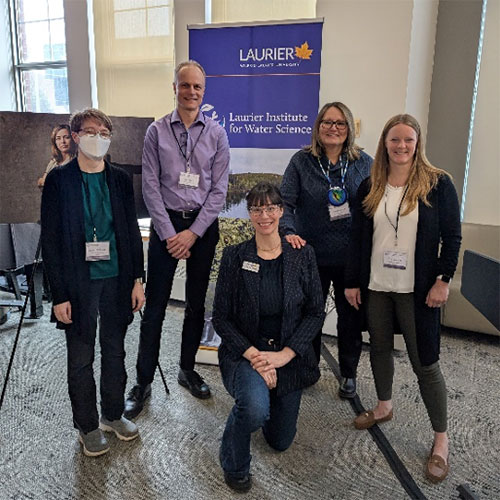
Print | PDFLast month, the Laurier Institute for Water Science (LIWS) brought together researchers, students and community members to mark World Water Day under this year's United Nations theme of “Where Water Flows, Equality Grows.” For the first time, LIWS co-hosted a panel discussion with the Laurier Centre for Women in Science (WinS) placing gender equity at the centre of water discourse.
The World Water Day event opened with a keynote address by Andrew Thompson, a postdoctoral fellow in the Environmental Toxicology Research Group in Laurier’s Department of Biology. His research on the intersection of climate change and freshwater ecosystems set the stage for the day's broader themes of interdependence between ecosystems, communities and the crises we too often treat as separate.
That thread of interdependence ran through the panel that followed, which brought together four Wilfrid Laurier University researchers whose work spans political ecology, Indigenous governance, aquatic toxicology and cellular biology. Moderated by Eden Hennessey, research and programs director of WinS and data specialist in Laurier's Office of the Associate Vice-President, Equity, Diversity, and Inclusion, the discussion opened with alarming statistics.
"According to United Nations estimates, women and girls globally spend a collective 200 million hours every single day collecting water, yet their voices remain largely absent from the spaces where solutions are designed,” Hennessey told the audience. “Women make up less than 17% of the water UNESCO sector workforce, and an even smaller minority in research and decision-making roles."
Hennessey presented the audience with a direct question to frame the panel discussion: what would water science look like if it truly included everyone?
Sheri Longboat, associate professor of Geography and Environmental Studies, presented her research on Indigenous water access and the critical need for a coordinated transdisciplinary approach to ensuring water security for Indigenous communities. Her work makes clear that reconciliation and water justice are not parallel tracks – they are the same road, and progress on one cannot be separated from progress on the other.
Where Longboat's research focused on governance and rights within Canada, Alex Latta, associate professor in the departments of Global Studies and Geography and Environmental Studies, widened the frame, sharing stories of water defenders in Latin America who have faced threats and violence for advocating on behalf of their communities and waterways. His work in political ecology is a reminder that the struggle for water is often, at its core, a struggle for the right to be heard, and that those most at risk are frequently the same communities already excluded from the rooms where decisions are made.
Erin Leonard, assistant professor of Biology, reminded the audience of the power of science to change beliefs and attitudes, speaking about the importance of a holistic approach to research that brings together laboratory findings and the world outside the lab. Her work links shifts in climate with changes in aquatic species behaviour and physiology. Leonard was clear that advocacy and rigorous science are not in opposition; she said communicating the human stakes of environmental change is part of what good science demands.
Allison McDonald, a professor in the Department of Biology, closed the panel by turning to the question of who gets to do that science in the first place. She spoke candidly about navigating systemic barriers as a woman in the field and paired that honesty with an enthusiasm for aquatic life rooted in childhood adventures along small-town waterways. McDonald’s message was one of persistence and possibility: the stories we tell about who belongs in science shape who shows up to do it, and changing those stories is as urgent as any research agenda. McDonald currently offers an upper year class on science communication for this very reason.
The panelists provided students in the crowd with several key takeaways to enhance gender equity and water justice:
“Taken together, the four presentations pointed toward a notion that, while obvious, bears repeating: water security and gender equity are not competing priorities to be balanced against one another, but deeply interconnected conditions that rise and fall together,” says Hennessey. “Building a more just water future and building more inclusive communities in science are not parallel projects. They are, in the end, one and the same.”
The Laurier Institute for Water Science is a multidisciplinary research institute focused on hydrological sciences, ecology and biogeochemical sciences, and public policy and management. The Laurier Centre for Women in Science (WinS) works to advance equity and inclusion in STEM fields. Follow WinS (@laurierwins) on Facebook, Instagram, LinkedIn.